

Studying policymaking in Australia to benefit Bangladesh
Posted: 12 March 2026
Khin Won Nu from Bangladesh is studying a Master of Public Policy at Flinders University in South Australia, with the support of an Australia Awards Scholarship.
In the following video, Khin discusses her experiences as an Australia Awards scholar in Australia.
In recent years, many countries worldwide have experienced complex and turbulent situations at a national level—and, Khin says, “Bangladesh is no exception.” In order to address such challenges, she says, “My country needs to improve the standard and quality of policy formulation and its effective implementation.”
This perspective motivated Khin to pursue additional tertiary study, a decision that in turn led her to apply for an Australia Awards Scholarship. She says that she chose this Scholarship over others available “because it is the most prestigious one”, noting that it offers scholars both financial support and an opportunity for growth by gaining knowledge and skills in Australia. “I want to use this knowledge for the development of my country and to make a change in my country,” she says.
Khin describes the learning environment in Australia as being very different to that of her previous schooling experience. “The education quality in Australia is just world class,” she says. “At university, the focus is not only on the academic excellence, but also on the critical thinking, innovation and group discussion.” She notes that her lecturers are “very proactive and supportive”, and that they encourage open discussion and debate. She also applauds the university facilities, calling the library systems, modern laboratories and student services “very exceptional” and “excellent”.
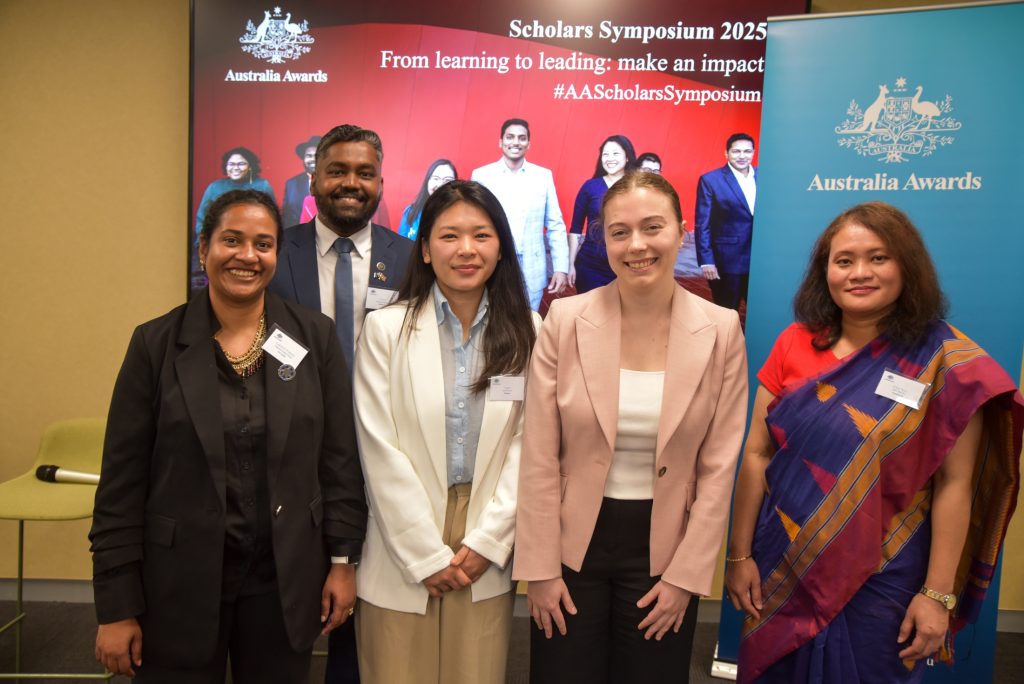
Khin (right) with Senator Charlotte Walker (second from right), Senator for South Australia, alongside scholars from Sri Lanka, Maldives, and Bhutan at the 2025 Scholars Symposium in Adelaide.
Despite education being her number one priority, Khin’s days in Australia haven’t been limited just to her academic pursuits; when not studying, she has found time for off-campus activities too. “I enjoy exploring the natural beauty of South Australia, visiting beaches and walking along trails,” she says. Closer to the city centre, she visits the local markets, helping give her a broad perspective on life in Adelaide.
“I enjoy the safe, peaceful and multicultural environment of Australia,” she says, adding that the people she has encountered in Australia have been “very friendly and respectful”. As well as participating in many student societies, she also takes part in a great number of community events that promote cultural exchange. She describes these as “a great opportunity for me to connect and network” with people from all over the world, as well as “gain much more experience to help in my professional and personal life”.
In many ways, what has impressed Khin most about Australia is its rich combination of many cultures—from “the ancient heritage of Aboriginal and Torres Islander communities” to its present-day multiculturalism, “which is shaped by immigrants from all over the world”.
Khin’s Scholarship experience reflects this diversity. She notes that the Australia Awards program promotes “inclusion and equity”, and says, “As someone from [an] indigenous community from Bangladesh, the Scholarship has given me the chance to study with respect and confidence.” She adds that studying in Australia has given her the opportunity “to share the needs and the voices” of her community with people around the world.
Khin has benefitted from both professional development and cultural learning opportunities through Australia Awards, including learning more about Australia’s Indigenous peoples. At the 2024 Scholars Symposium in Adelaide, she joined other scholars from South Asia and Mongolia on a walking tour led by an Indigenous guide, which included a smoking ceremony.
The Symposium also provided opportunities to hear from experts on changemaking, reflect on her Development Impact and Linkages Plan, and further develop her leadership skills. “The Symposium was very helpful, as it gave me the opportunity to gain knowledge on how to link my future plans with the academic program I am undertaking through the Australia Awards Scholarship,” she says.
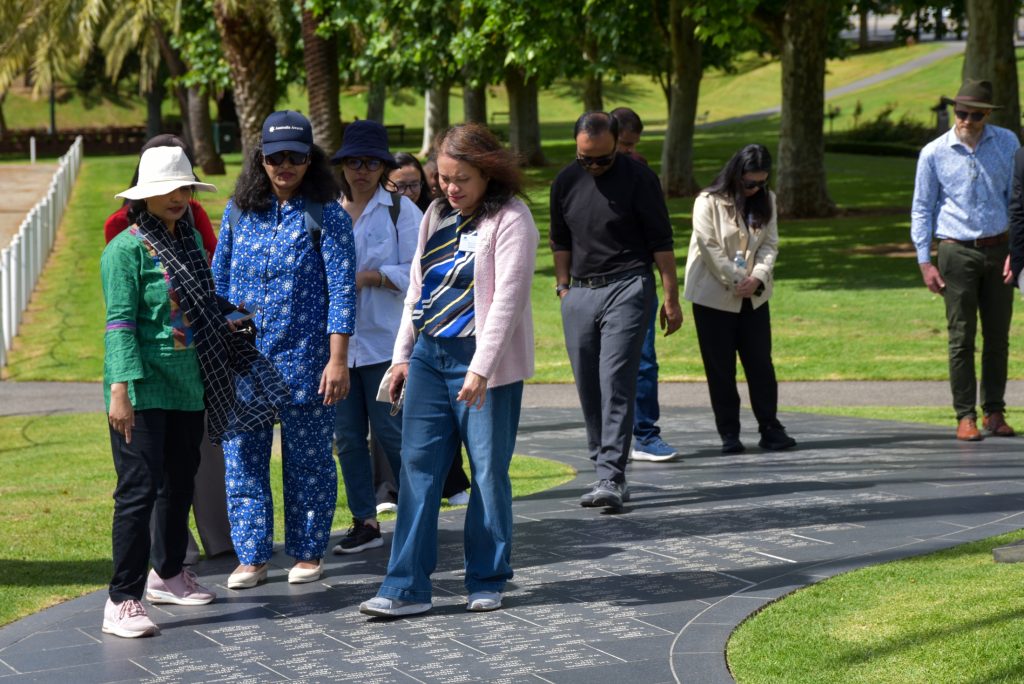
Khin with other scholars participating in an Indigenous-led walking tour of Adelaide’s CBD during the Scholars Symposium in Adelaide.
In addition, she describes the broader support she has received both from Australia Awards and from the university as “just tremendous”. This support began with the pre-departure briefing in her home country and continued in the form of assistance with the process of acquiring a visa and finding accommodation, as well as with settling in as she adjusted to life in Australia. Tailored support and assistance of this type is offered to all Australia Awards scholars. “The financial support we have received,” she adds, “ensures that we will stay here comfortably and just focus on our studies.”
When asked for her advice to other people from indigenous groups in Bangladesh who may be thinking about applying for an Australia Awards Scholarship, Khin is forthright. “Just believe in your abilities. Your background is not your weakness. It is your strength,” she says. “Apply with confidence. Tell your story honestly and remember that you have the power to connect your community with a better future.”
Finally, Khin also has a powerful message for all prospective Australia Awards Scholarship applicants, no matter what their background. “It’s more than a Scholarship,” she says with certainty. “It’s a journey that will shape your future and broaden your perspective.”